


Advisors didn’t choose this profession to manage paperwork, compliance tasks, and disconnected technology. They chose it to serve clients, create impact, and build something meaningful.
And for most growth-minded Advisors, that passion never left.
What changes over time isn’t motivation; it’s capacity.
As businesses grow, complexity quietly compounds. More clients, decisions, and systems to manage. When the business isn’t designed to absorb that complexity, work that once felt energizing can start to feel heavy.
This is not a personal shortcoming. It’s a design issue.
Joy fades when advisory businesses aren’t supported by an infrastructure designed for intentional growth.
In contrast, infrastructures that absorb complexity and restore capacity can help Advisors win back more than time. With the right systems, Advisors can gain fuel for creativity, strategic growth, deeper client relationships, and renewed joy.
This is what makes a Financial Advisor’s operations so critical.
It’s also why more Advisors are seeking improved RIA infrastructures and Advisor platforms. Not to compromise independence, but to reclaim passion for their business, and accelerate growth.
Related: Claiming Independence, Cutting Ties With a Large Firm, Trusting Your Gut, & Letting Go
How Financial Advisor Growth Can Create Friction
Growth is positive.
But without the right structure, it creates predictable pressure points.
1. Advisors Doing Too Much of the Wrong Work
Like most entrepreneurs, Advisors end up wearing every hat:
Operations. Compliance. Technology oversight. Team management. Vendor wrangling.
Constant context switching dilutes focus. Strategic thinking gets crowded out. Client-facing work gets squeezed between “necessary” internal demands.
When everything runs through the Advisor, the business can’t create leverage. It can only create dependence.
2. Growth Without Infrastructure
In theory, having a growing roster of clients should create momentum. Instead, without the right infrastructure, growth introduces exceptions, manual work, and complexity.
More clients without the right infrastructure can often create:
- More exceptions
- More one-off requests
- More workflows to manage
- More decisions that live in your head
Systems that worked at an earlier stage begin to strain. Processes break under volume. What felt manageable starts requiring effort just to maintain.
Growth should feel lighter over time.
If it feels heavier, infrastructure is likely the constraint.
3. Fragmented Systems & Tools
Technology is meant to simplify work.
But when platforms don’t integrate, the opposite happens:
- Duplicate data entry
- Manual workarounds
- Inconsistent workflows
- Extra steps that add zero value
Instead of creating clarity, technology introduces friction. Advisors spend time managing systems rather than using them.
4. Emotional Resistance to Delegation
Even when support is available, letting go can feel uncomfortable.
There’s fear of losing control. Fear of diminished quality. Fear of losing identity within the business.
What enables Financial Advisors to successfully delegate their responsibilities?
Financial Advisors can delegate successfully when they have trustworthy systems and clearly defined processes in place. Reliable infrastructure gives Advisors the confidence to hand off their responsibilities without sacrificing the client experience or operational outcomes.
When confidence in systems is low, delegation breaks down. Then, an Advisor will tend to hold onto tasks, and their capacity will likely remain limited.
This is why Advisors must build or find infrastructure they can trust. Then, they can gain capacity for growth and win back joy.
Your Next Step: Resources for Financial Advisors
If you are a growth-minded Advisor feeling the drive to reclaim your passion, it may be time to step back and evaluate the structure supporting your business.
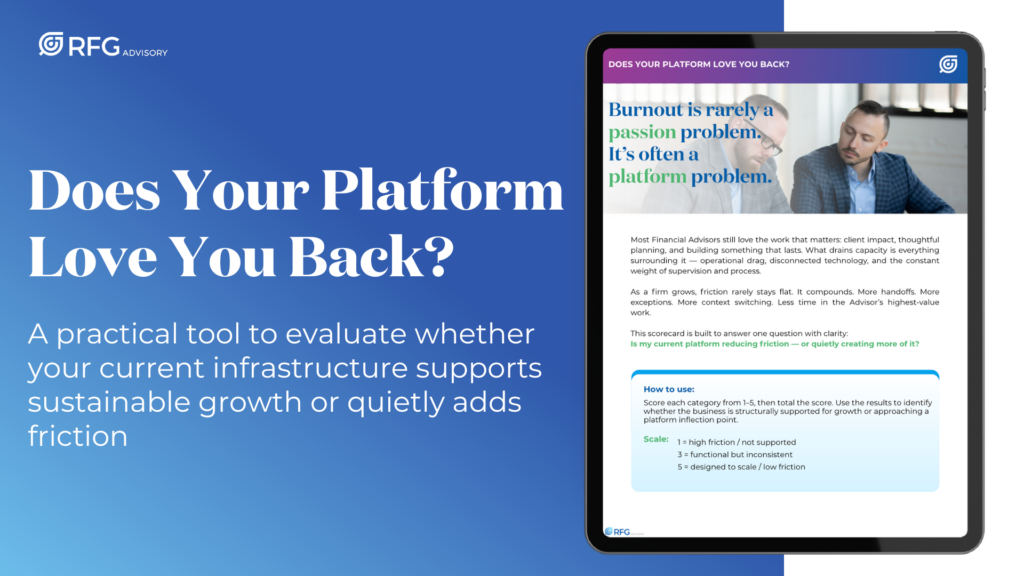
To help, RFG Advisory created a practical scorecard designed to help you identify:
- Where operational friction shows up in your business
- Whether your current model can realistically support continued growth
- If your current infrastructure is creating leverage or complexity
Download the “Does Your Platform Love You Back?” Scorecard and take the first step towards designing a business that supports what you love most.
Why Intentional Design Is the Turning Point
High-performing advisory businesses aren’t patched together. They’re designed.
Intentional design starts with stepping back and asking whether the business was built to absorb growth or simply react to it.
Design includes:
- Clear roles and responsibilities
- Repeatable, documented processes
- Systems intentionally built to scale
- Infrastructure that reduces decision fatigue
When structure is thoughtfully engineered, it creates confidence. Decisions become easier. Work becomes more predictable. The business begins to support the Advisor, not the other way around.
Design doesn’t eliminate effort. It restores capacity.
How the Right Infrastructure Restores Joy
When operational drag is removed, something important happens.
Time returns. Mental space opens up.
Advisors regain energy by working on the business instead of constantly working through the friction. Client relationships deepen because attention isn’t divided. Leadership becomes more intentional. Growth becomes sustainable instead of exhausting.
This is why the right infrastructure is critical. It allows Advisors to pursue what matters most. It can empower them to deepen meaningful relationships, multiplying their impact, and grow their business with purpose.
Ready to Learn How RFG Can Help You Reclaim Your Passion?
At RFG, we’ve built a corporate RIA platform designed to help you remove operational bottlenecks, win back time for your passions, focus on what matters, and Build Your Business Without Compromise™.
To learn more, schedule your confidential 15-minute call.
Financial Advisor burnout is rarely caused by a lack of passion. It is usually caused by a business where admin crowds out client work. According to RFG Advisory’s ClickONE data, the average Advisor spends the majority of their day on admin rather than clients. The right infrastructure changes that equation. RFG Advisory’s ClickONE gives Advisors up to 20 hours back each week.
ClickOne – RFG Advisory
Advisors struggle to delegate when they lack confidence in their systems and processes. Fear of losing control, diminished quality, or loss of identity within the business creates resistance. Financial Advisors delegate successfully when trustworthy systems and clearly defined processes are already in place. Reliable infrastructure is what makes letting go feel safe rather than risky, and it is the foundation that restores capacity.
An RIA platform is helping when it reduces the number of decisions hitting your desk, supports repeatable processes, and allows delegation without sacrificing client experience. It is hurting when it demands constant management and keeps the Advisor as the single load-bearing point. RFG Advisory’s “Does Your Platform Love You Back?” scorecard is a practical tool for making that assessment honestly.
Advisory Platform Growth Scorecard | RFG Advisory
The right corporate RIA platform removes operational drag by providing integrated technology, documented processes, shared services, and infrastructure that absorbs complexity instead of passing it to the Advisor. When friction is removed, time and mental space return. Client relationships deepen. Growth becomes sustainable. RFG Advisory was built specifically to help Advisors reclaim capacity and lead their businesses with renewed purpose.
Build Your Business Without Compromise | Join RFG Advisory