


 By Brendan Frazier | Chief Behavioral Officer
As a successful Advisor, you may notice a shift when your business grows.
Your calendar is booked, clients are happy, and things haven’t changed fundamentally.
Yet your momentum has slowed.
Your responsibilities seem heavier. Decisions take longer, and small issues just seem bigger.
If this sounds familiar, you’re likely asking the same question other Advisors ask:
Is it me?
Most often, the answer is no.
Advisors typically don’t experience this drag because their skills are no longer effective. Most commonly, friction has quietly crept in because their environment doesn’t create trust.
This is often why growth stalls. Not because you lack drive, talent, intelligence, motivation, or passion. But because your environment has eroded trust.
This moment is also an opportunity. The right environment can give you the mental space, infrastructure, and clarity needed to reclaim momentum.
When Trust Erodes, Motivation Falls.
Most Advisors don’t suddenly lose motivation.
Instead, they begin feeling a sense of hesitation. A growing low-grade tension that starts to make simple decisions take more mental energy than they should.
Psychologists have long understood that motivation isn’t just about confidence or ambition. Expectancy Theory teaches us that motivation depends on three things: belief in your ability, desire for the outcome, and confidence in the environment supporting your efforts.
When just one of these fails, so does motivation. For Advisors, confidence in their environment is often what fails.
You can have confidence in your abilities and a clear passion for growth. Still, unpredictable people or systems can drive motivation down.
When this happens, mental energy can be redirected toward managing processes outside of your control and dealing with the drain of operational friction.
This is why Advisors don’t just need confidence. They need infrastructure they can trust.
Trust Isn’t Just a Feeling. It’s About Infrastructure & Community.
Trust is often described in emotional terms. In reality, it shows up operationally and in community.
Tension can build when trust is low. What it looks like:
- Worrying that a routine compliance question will bring unwarranted scrutiny instead of clarity
- Fixating on perfection to avoiding violating an unnecessary policy
- Concern that speaking up will create hassle instead of solutions
None of these are dangerous on their own, and that is what makes them dangerous. Overtime they can compound and quietly begin to occupy your mental space.
Operational friction compounds the same way. What it looks like:
- Tasks that should move smoothly require follow-up
- Requests disappear into systems that feel disconnected from outcomes
- Rework is needed because communications create more questions than answers
Each instance is small. But together they drain time, attention, and momentum.
A dismissive community can feel exhausting. What it looks like:
- An apathetic “no” from compliance
- A home office uninterested in feedback
- Working with peers who are competitive, rather than collaborative
Some may frame community as nonessential. But when clarity is gained from interactions with peers and real solutions are driven by collaboration, community becomes a growth lever.
Wondering if Your Environment is Still Right for Your Business?
If any of this sounds familiar, the next step isn’t to fix yourself; it’s to examine your environment.
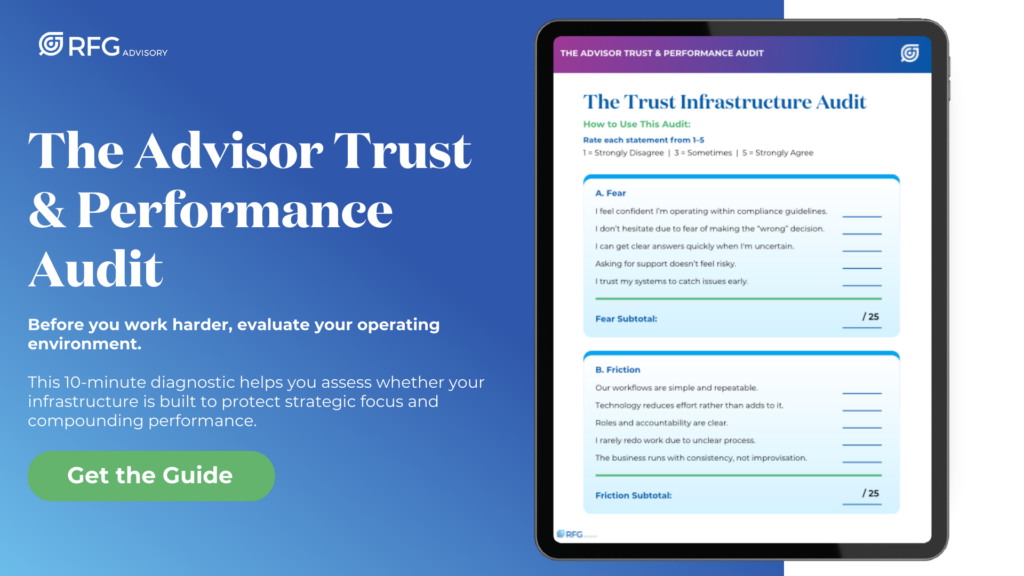
How Trust Becomes Leverage
When a business begins to grow, Advisors can often push through the friction. As growth continues, that strategy often stops working, and a new approach becomes necessary.
Trust-based environments are a behavioral strategy for Financial Advisor growth.
They don’t just feel better; they can drive:
- Consistency that fosters mental capacity and scale
- Clarity that fuels creativity for strategic planning
- Guidelines that enable focus for growth
- Community that instills confidence in decisions
This is why trust is not a buzzword. It’s leverage.
Trusted Coaching for Financial Advisors Turns Confusion into Confidence.
Confidence fuels growth, and clarity decides the direction.
Coaching shouldn’t add more complexity. It should help you separate real strategies from fluff.
A trusted coach helps reframe decisions, challenge assumptions, and reduce the mental friction that comes from carrying the weight of complexity alone. They don’t just offer answers; they increase your confidence in how you make decisions.
When confidence reduces decision fatigue, you can gain the clarity needed to grow.
Related: Coaching for Financial Advisors: How to Think Like a CEO
Trusted Community for Financial Advisors Turns Doubt into Direction.
Isolation is where self-doubt thrives.
Community answers a deeper question many Advisors don’t realize they’re asking.
“Is it just me?”
Hearing peers describe their challenges can validate your perspectives. Then, decisions that used to take months of internal debate can happen in minutes.
The right community isn’t just emotional support. It’s strategic fuel for emotions and executive function.
Related: Advisor Growth Study Club
The Opportunity
Drag is rarely about willpower.
Successful Advisors almost never stall because they lack ambition or skill. They stall when trust is low and tension, operational friction, and isolation compound in their environment.
This is also where the opportunity lies.
You can win back your mental energy by reshaping your environment or finding a new one designed for trust.
Ready To Consider a New Environment?
At RFG, we’ve built an environment designed to help you build trust, gain clarity, remove operational friction, and gain fuel with a community that genuinely cares about your success.
To learn more, schedule your confidential 15-minute conversation.