


Fidelity’s $100 Million RIA Custody Minimum requirement has some RIAs reconsidering where and how they operate. If you are already evaluating a foundational piece of your business, do not stop at custody. It may be time to evaluate the infrastructure around your independence.
Fidelity Investments is extending a $100 million custody-platform asset minimum to existing RIA clients. Firms below the threshold have until June 30, 2027, to meet it or begin discontinuing their custodial relationship with Fidelity.
For Independent Financial Advisors affected by the change, the immediate question may be: Where should I custody client assets next?
But that may not be the most important question. Advisors should ask:
Is the infrastructure around my business still built for where I want to go next?
At RFG Advisory, we fiercely believe independence is the winning model for Financial Advisors. We also believe independence should not mean doing everything yourself.
What Does Fidelity’s $100 Million RIA Custody Minimum Mean?
Fidelity’s new policy extends its $100 million custody-platform asset minimum to existing RIA clients. Fidelity has said firms below the threshold have until June 30, 2027, to meet it or discontinue their custodial relationship. Fidelity had already applied the same minimum to RIAs newly joining its custody platform.
The distinction matters for firms using multiple custodians. The $100 million requirement is based on assets held at Fidelity, not total firm AUM. An RIA could therefore manage more than $100 million overall and still be affected if less than $100 million is custodied with Fidelity.
That leaves affected Advisors with decisions to make about whether to consolidate more assets at Fidelity, move to another custodian, or reconsider the infrastructure and affiliation model supporting their business.
If Your RIA Is Below Fidelity’s $100 Million Minimum, What Are Your Options?
There is no single answer for every Independent Advisor. Depending on your business and long-term goals, potential paths include:
| 01 | Consolidating additional client assets onto Fidelity’s custody platform to meet the minimum. |
| 02 | Moving some or all client assets to another custodian. |
| 03 | Maintaining a standalone RIA with a different custody relationship. |
| 04 | Evaluating an independent RIA platform that provides the technology, infrastructure, people and support behind your business. |
That fourth option deserves more attention than simply asking which custodian has the next-lowest minimum.
Changing custodians can involve meaningful operational work, paperwork and client approvals. If you are going to take on that level of change, it may be worth evaluating the entire operating model behind your business.
Don’t just ask where your assets should go. Ask what you want your business to look like on the other side.
Independence and Operating a Standalone RIA Are Not the Same Thing
For years, independence has often been framed as a binary choice: stay within a larger institution, or build and manage the infrastructure yourself.
That is no longer the only path.
Independent Financial Advisors can operate with significant autonomy while gaining access to the infrastructure of a larger RIA platform. For RFG, independence means Advisors are empowered to build enterprise value for themselves and their families, remain at the center of their client relationships and have greater control over what they build.
It does not mean every Advisor needs to independently assemble technology, manage integrations, build operational workflows, staff every function or solve every infrastructure problem.
Own the business. Own the client relationship. Own what you build. Let your platform carry more of the infrastructure behind it.
The Economics of Independence Are Changing. Your Ambition Does Not Have To.
Custody is only one layer of the infrastructure required to operate a modern advisory business. Independent Advisors are also navigating technology integration, cybersecurity, compliance, data, AI, client onboarding, account opening, money movement, investment management, marketing, talent and increasingly sophisticated client expectations.
The complexity behind independence has changed. That does not make independence less attractive. It makes the infrastructure supporting independence more important.
If you became independent to serve clients differently, build something you own and create long-term enterprise value, spending your best hours managing vendors, reconciling systems and solving operational problems can work against the reason you chose independence in the first place.
What Is a Corporate RIA Platform?
A corporate RIA platform allows Financial Advisors to operate within a larger registered investment adviser while accessing shared technology, compliance, operations and other infrastructure. Models vary significantly, which makes due diligence important.
Advisors evaluating RIA platforms should understand how each firm approaches ownership, economics, brand flexibility, technology, investment management, custody, compliance, data, transition support, culture and long-term enterprise value.
For the right Advisor, the model can provide another path to independence: one where the Advisor stays focused on clients, relationships, growth and the business they are building while a larger platform supports more of the infrastructure underneath it.
Is RFG Advisory an Option for Advisors Affected by Fidelity’s $100 Million Minimum?
Yes. RFG Advisory is an AI-powered RIA platform for Independent Financial Advisors and may be an option for Advisors who want to remain independent without continuing to operate every component of a standalone RIA themselves.
ClickONE™, RFG’s integrated operating system, automates back office, CRM, marketing, onboarding and portfolio management, backed by institutional-caliber, in-house asset management. The goal is to give Advisors more time for the client relationships that drive organic growth and enterprise value, building on more than a decade of operating this model at scale.
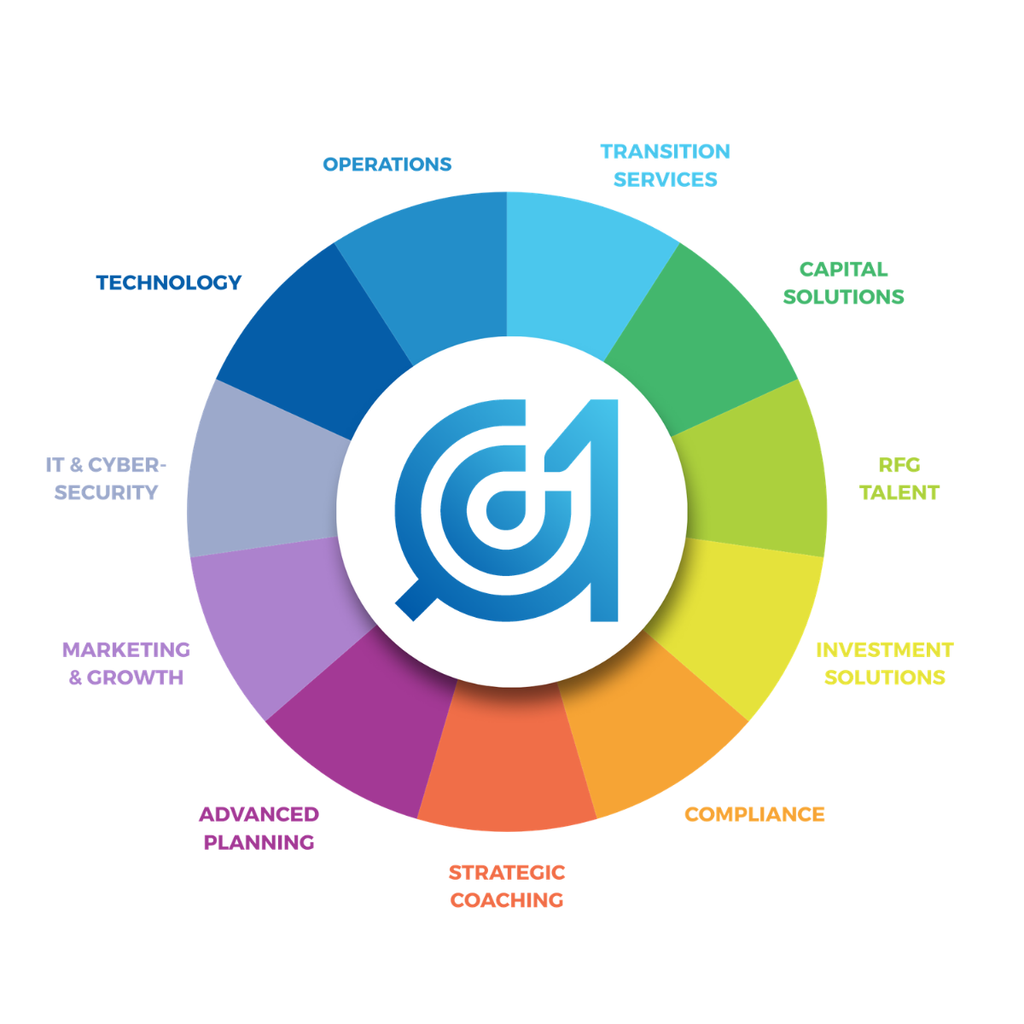
Around that technology is the RFG Flywheel: transition services, capital solutions, talent, investment solutions, compliance, strategic coaching, advanced planning, marketing and growth, IT and cybersecurity, and operations.
RFG is not positioning technology as a replacement for the Advisor. We are a services firm first and a technology firm second. Great firms are built by great Advisors. Technology should help redeploy human capacity toward better client outcomes, organic growth and enterprise value.

Transition Support Matters When Change Is Already on the Table
If an Advisor is already facing a custody or platform decision, the quality of the transition experience matters. For Advisors already custodying assets with Fidelity, moving Fidelity assets to RFG can be a minimal-impact experience for clients. Because the assets remain at Fidelity, eligible accounts may be able to move without a traditional custodial repapering process, helping reduce client disruption and operational lift.
RFG pairs that structural advantage with a dedicated transition team and Dash, its AI-native transition technology, built around the Advisor and client experience. Dash provides visibility into the transition, including onboarded assets and households that need attention, while streamlined data gathering helps keep the move moving forward.
RFG’s corporate RIA structure and scale also mean the Advisor is joining a larger firm with an established Fidelity relationship, so Fidelity’s standalone RIA minimum is not a constraint. The result is a transition designed to minimize client impact, move with speed and help the Advisor get back to serving clients and building the business sooner.
Technology Matters, but Technology Alone Is Not the Answer
AI is rapidly changing what is possible inside an advisory business. RFG believes those capabilities should be used to make the business smarter and more efficient without making financial advice less human.
RFG’s approach is built around connected data, secure connectivity, APIs, agent workflows, automation and productivity tools. But the philosophy underneath that technology matters just as much as the technology itself.
We build technology for Advisors and their clients. The goal is to automate more of the work technology can do so Advisors have more capacity for what only they can do: understand clients, make judgment calls, build trust, deepen relationships and deliver better outcomes.
Changing Platforms Is a Business Decision, Not Just a Custody Decision
For Advisors affected by Fidelity’s new custody minimum, there is an understandable temptation to solve the immediate problem first: Where can I move my accounts?
Before answering that question, step back and ask what you are trying to build over the next five or ten years.
- Do you want to add clients without adding equivalent operational complexity?
- Do you want to spend less time managing technology and workflows?
- Do you want deeper investment management or advanced planning capabilities?
- Do you want marketing and organic growth built more directly into how you run the business?
- Do you want to build a high-performing team without building every capability internally?
- Do you want better visibility into growth, profitability, capacity and enterprise value?
- Do you want to remain independent without remaining responsible for every piece of infrastructure?
Your answers may change the type of solution you should evaluate.
If Infrastructure Matters More, Connected Infrastructure Matters Most
Adding more technology does not necessarily create scale. Disconnected systems can create more work, more reconciliation and more places for information to get lost.
RFG’s technology strategy starts with connected data. ClickONE™ is the operating system through which Advisors can run their businesses, turning connected data into intelligence and action and automating more of the work while keeping the Advisor at the center of the client relationship.
That connected infrastructure extends across the business:
- Technology: connected data, intelligence, workflows and automation designed to help Advisors act faster while remaining in control.
- Operations: digital account opening, custodial support, money movement and servicing through connected technology and a team built to execute. RFG’s scale and established relationships with Fidelity and Schwab also give our Advisors access to top-tier custodial support teams, creating a stronger service experience and a more direct path to support when issues need attention.
- Marketing & Growth: campaigns, website updates and identifying and activating opportunities integrated directly into ClickONE™.
- Investment Solutions: institutional-caliber investment management, custom designed around client needs, with the flexibility for Advisors to stay involved or hand off portfolio management.
- Advanced Planning: technology surfaces the opportunity and human expertise brings it to life, from everyday planning to complex, high-net-worth needs.
- Compliance: technology and a dedicated team build oversight into the workflow to help save time, manage risk and protect enterprise value.
- IT & Cybersecurity: dedicated expertise protecting the connected data, systems and infrastructure powering an AI-native business.
- Talent: technology and AI help unlock time and enable modern organizational design so human capital can be deployed toward better client outcomes and growth.
What Should Advisors Look for When Comparing RIA Platforms?
If you are considering moving from a standalone RIA to an independent RIA platform, look beyond a headline payout or a long technology list. Evaluate the operating model.
Understand ownership, economics, client and data ownership, brand flexibility, custody options, investment flexibility, compliance support, transition resources and technology architecture.
Then look at the people. Who answers when something goes wrong? Who helps your team execute? How much work actually comes off your plate? Does the technology connect the business, or simply give you another collection of tools?
Does the platform make you more independent in the ways that matter, or simply give you a different set of constraints?
The Future of Independence Is Supported, Connected and Advisor-Led
Fidelity’s $100 million custody minimum is one change at one company. But it underscores a larger reality for Independent Advisors: the infrastructure required to operate and compete continues to become more sophisticated.
Scale matters. Connected data matters. Technology matters. Human expertise matters. Operational leverage matters.
That does not mean Advisors need to give up independence. It means the model supporting independence matters more.
At RFG, we believe Advisors should own what they build, remain at the center of their client relationships and have access to an operating platform capable of growing with them.
You should not have to choose between independence and infrastructure.
Already Reconsidering Your Custodial Relationship? Think Bigger.
If Fidelity’s $100 million custody minimum has you evaluating what comes next, this may be the right time to look beyond custody.
Pressure-test your technology. Pressure-test your operations. Pressure-test your support model. Pressure-test the amount of time you spend running the business instead of building it.
Then decide what kind of independence you want for the next chapter.
RFG Advisory is an AI-powered RIA platform for Independent Financial Advisors who want to own what they build without having to build and manage every function behind their business.
See what independence looks like with RFG.
Frequently Asked Questions
RIAs below Fidelity’s $100 million custody minimum can consider bringing more assets to Fidelity, moving to another custodian, or joining a larger RIA platform with an established Fidelity relationship.
RFG Advisory is one option for Advisors who want to remain independent and maintain access to Fidelity while gaining the scale, technology, infrastructure and support of a larger RIA platform.
Yes. Operating your own standalone RIA is not the only path to independence. Advisors may be able to affiliate with a larger RIA platform that has an established Fidelity relationship.
RFG gives Independent Advisors another path: maintain the ownership and independence you value while gaining the scale and infrastructure to handle more of the technology, operations, compliance and work behind your business.
The right RIA platform depends on what you want to own, what you want to control and how much of the business you want to operate yourself.
RFG Advisory is built for growth-minded Independent Advisors who want more than a custody solution. RFG combines ClickONE™, its AI-powered operating system, with human expertise across operations, compliance, investment management, advanced planning, marketing, talent and transitions, giving Advisors the infrastructure to build a stronger, more valuable business.
Start with custody, but do not stop there. Compare ownership, economics, technology, client and data ownership, compliance, operations, investment capabilities, transition support, marketing, talent, culture and long-term enterprise value.
RFG believes independence is the winning model. But independence should not mean building every system, staffing every function and carrying every operational burden yourself. The right platform should strengthen your independence, not dilute it.
Yes. Fidelity’s custody change may be a signal of something bigger happening across the industry.
If you are already being forced to evaluate a foundational piece of your business, it is worth asking a bigger question: Do you still want to manage the technology, compliance, operations, investment infrastructure and other demands of running a standalone RIA on your own?
RFG Advisory offers another path. Advisors can remain independent while gaining the scale, infrastructure, technology and human expertise of a larger RIA platform. Because the question is not just where you custody assets next. It is what you want the business around your independence to look like next.
Sources include Barron’s, AdvisorHub, WealthManagement.com, and Citywire, cross-checked to verify Fidelity’s reported $100 million custody minimum and June 30, 2027 deadline.