


How Financial Advisors Can Reduce Operational Drag and Build a More Scalable Business
Your clients need you.
Your operations shouldn’t.
For many successful Financial Advisors, growth happens faster than the infrastructure behind the business evolves. As a result, Financial Advisor operations can become increasingly complex as the business adds clients, assets, technology, and team members.
And somewhere along the way, the Advisor becomes the person holding it all together.
A client needs something? Ask the Advisor.
A team member isn’t sure what happens next? Ask the Advisor.
A process gets stuck? The Advisor steps in.
Information lives in three different systems? The Advisor knows where to find it.
It may work. It may even work well.
But if your business depends on you to connect the people, processes, technology, and decisions required to keep it moving, you’re not just leading the business.
You’ve become its operating system.
And that can become one of the biggest barriers to your next stage of growth.
What Is Operational Drag in a Financial Advisory Business?
Operational drag is the time, effort, and complexity created by inefficient processes, disconnected technology, manual work, unclear responsibilities, and unnecessary Advisor involvement.
Operational drag often looks like:
- Multiple follow-ups for a client request
- Information entered into multiple systems
- Account openings waiting on an answer
- Advisor approvals that could follow a defined workflow
- Manually figuring out what needs attention
Individually, these moments may not seem significant.
Across hundreds of clients, thousands of tasks, and an entire year, they add up.
That matters because Advisors don’t have unlimited capacity.
Every hour spent navigating operations is an hour that can’t be spent deepening client relationships, developing the team, meeting prospective clients, thinking strategically, or building the long-term value of the business.
The goal isn’t simply to make operations faster.
It’s to build an operating model that requires less of the Advisor to run.
The Advisor Bottleneck Can Be Hard to See
Being the bottleneck doesn’t necessarily mean your business is disorganized.
In fact, it can happen precisely because you’re good at what you do.
You know your clients. You understand the history behind important decisions. You know which process to follow, which person to call, where information lives, and how to solve problems quickly.
So people come to you.
At first, that can feel efficient.
As the business grows, it becomes increasingly difficult to scale.
Consider how often your day is interrupted by questions like:
- Where does this stand?
- What do we need to do next?
- Who is handling this?
- Can you approve this?
- Where can I find this information?
- Did someone follow up with the client?
- Which system has the most current information?
- Can you help me resolve this issue?
If too many roads lead back to the Advisor, adding more clients can also mean adding more decisions, interruptions, administrative work, and operational complexity.
That’s not leverage.
That’s dependency.
Growth Requires Capacity, Not Just Opportunity
Financial Advisors tend to think about growth in terms of opportunity.
More referrals. More prospects. More assets. More households. More acquisitions.
But there is another question worth asking:
If those opportunities showed up tomorrow, could your business absorb them?
A business can have tremendous growth opportunity and still lack the capacity to capitalize on it.
Imagine adding 50 new client households this year.
Would that create excitement or operational anxiety?
Would your existing workflows absorb the additional activity? Would your team know exactly what to do? Could onboarding happen consistently? Would client service remain strong? Or would the additional growth ultimately create more work for you?
Financial Advisor operations should be considered part of your growth strategy.
The right operational infrastructure creates capacity before you need it.
What Does a Scalable Advisory Business Look Like?
A scalable advisory business doesn’t eliminate the Advisor.
It makes the Advisor more valuable.
The Advisor spends more time doing the work that requires their expertise, judgment, relationships, and leadership, while the infrastructure surrounding them handles more of everything else.
That typically means creating an environment where:
Processes are predictable.
Routine work follows clearly defined workflows instead of relying on individual memory.
Information is connected.
Teams aren’t constantly searching across disconnected systems to understand what is happening.
Ownership is clear.
People know who owns the next step without routing every decision through the Advisor.
Technology reduces work.
Technology should remove steps and surface information, not create another system the Advisor has to manage.
Support scales with the business.
Operational expertise and administrative capacity can expand as the business grows.
Exceptions are actually exceptions.
The Advisor gets involved when their judgment is valuable, not because the system doesn’t know what happens next.
The result is not simply greater efficiency.
It’s a business capable of moving without requiring the Advisor to personally push every task forward.
Start by Asking: What Actually Requires Me?
One of the most valuable operational exercises an Advisor can conduct is also one of the simplest.
Look at everything you do during a typical week and ask:
Does this actually require me?
Not:
“Can I do this faster?”
Not:
“Am I good at this?”
Ask whether your expertise, relationship, judgment, or leadership is genuinely required.
Client advice? Probably.
A meaningful planning conversation? Absolutely.
Coaching a team member? Potentially.
Following up on routine paperwork? Probably not.
Finding information across multiple systems? Definitely not.
Checking the status of an operational request? Ideally, no.
Manually moving information from one system to another? No.
The objective isn’t to remove the Advisor from the business.
It’s to remove the Advisor from work that prevents them from doing the things only they can do.
4 Ways to Build More Scalable Financial Advisor Operations
1. Systematize Repeatable Work
If something happens regularly, it shouldn’t require someone to reinvent the process every time.
Client onboarding, account maintenance, money movement, meeting preparation, follow-up, service requests, and other recurring activities should have clear workflows.
Define the trigger. Define the owner. Define the steps. Define where information lives. Define what requires escalation.
The less ambiguity built into the process, the less likely the Advisor is to become the default decision-maker.
2. Delegate Ownership, Not Just Tasks
Delegation doesn’t create much leverage if the Advisor still has to assign the task, explain it, monitor it, answer questions about it, and verify that it was completed.
Real delegation transfers ownership.
Your team should understand not only what needs to happen, but what outcome they own and when the Advisor actually needs to become involved.
That creates something much more valuable than a completed task.
It creates capacity.
3. Connect Your Technology and Data
Technology should make the business easier to operate.
Yet many Advisors have accumulated technology one solution at a time: CRM, financial planning, portfolio management, reporting, marketing, document management, compliance, communications, and more.
Each system may be valuable independently.
The problem appears in the space between them.
When systems don’t communicate, people become the integration layer. Information gets manually transferred. Teams search for answers. Advisors jump between platforms. Work gets duplicated.
A scalable technology environment should reduce those handoffs by connecting data, workflows, and systems so information can move with less manual intervention.
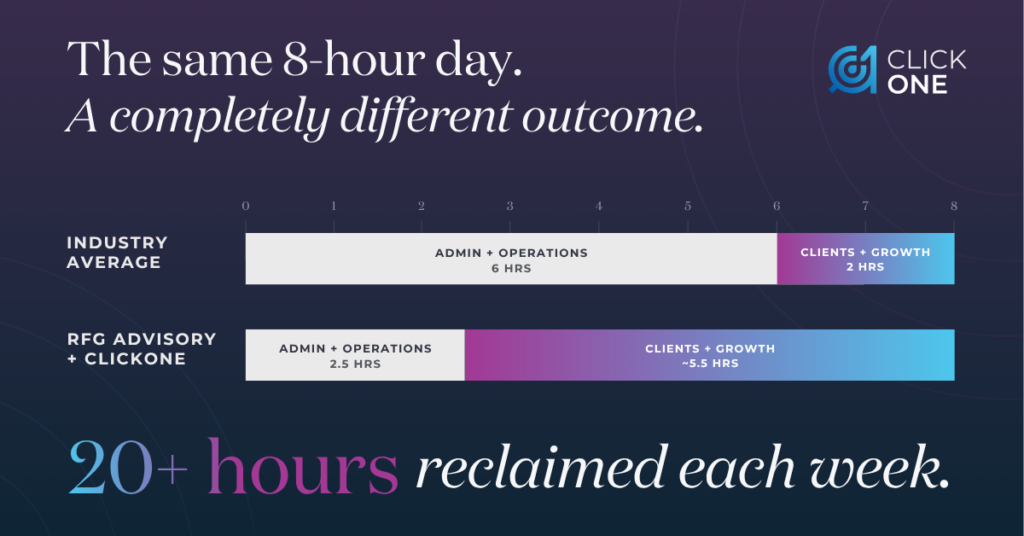
Your Technology Should Work Together. So Should Your Business.
ClickONE brings the technology, data, and workflows behind your business into one connected operating environment designed to reduce operational friction and give Advisors more time back.
4. Build Support Around the Advisor
Independence doesn’t have to mean building every capability yourself.
Operations. Technology. Compliance. Investment management. Marketing. Talent.
An Advisor can spend years assembling and managing each of these functions independently. Or they can build around infrastructure that already exists.
The important question isn’t simply, “What support do I have?”
It’s:
How well does that support work together?
When each function operates independently, the Advisor can still end up coordinating everything.
When they are connected, the business starts operating more like a system.
Better Operations Can Create a Better Client Experience
Operational efficiency isn’t only about the Advisor.
Clients feel it too.
They experience it when onboarding feels organized. When requests are handled consistently. When their Advisor already has the information needed for the conversation. When follow-up happens when expected. When the team knows what is happening without requiring the client to repeat themselves.
The best operations often become invisible.
The client doesn’t see the workflow, technology, automation, or team structure behind the experience.
They simply experience a business that feels responsive, organized, and intentional.
That’s why operations and client experience shouldn’t be treated as separate strategies.
The experience clients see is often a direct reflection of the infrastructure they don’t.
Operations Can Influence Enterprise Value, Too
There is another reason to build a business that doesn’t depend on the Advisor for everything.
A business that relies heavily on one person can be harder to scale, transition, or eventually operate without that person.
A business with repeatable processes, connected infrastructure, a capable team, clear ownership, and predictable workflows is different.
It has structure.
It has leverage.
It has the potential to operate beyond the founder.
That distinction matters when Advisors begin thinking beyond production toward building enterprise value.
The question changes from:
“How much revenue can I personally generate?”
to:
“What am I building that can continue to create value beyond me?”
Operations are an important part of that answer.
Build a Business That Runs With You, Not Through You
At RFG Advisory, we believe Advisors shouldn’t have to choose between independence and infrastructure.
The RFG Growth Flywheel brings together operations, technology, compliance, investment solutions, talent, marketing, strategic coaching, and other capabilities in one connected ecosystem designed around the Independent Advisor.
Within Operations, centralized support, integrated systems, workflow automation, and RFG’s ClickONE operating environment are designed to reduce manual work and operational friction so Advisors can spend more time where they create the most value.
Because the goal isn’t to make Advisors better at managing operations.
It’s to build businesses where they have to manage less of it.
Your clients should depend on your advice.
Your team should benefit from your leadership.
Your business should reflect your vision.
But you shouldn’t have to be the operating system holding everything together.
Ready to see what your business could look like with less operational drag?
Schedule a 100% confidential call with RFG Advisory to explore an operating model designed to give Advisors more time, capacity, and room to grow.
Financial Advisor operations include the processes, people, technology, and administrative infrastructure required to run an advisory business. This can include client onboarding, account administration, money movement, custodial support, workflow management, data management, reporting, documentation, and other back-office functions.
Operational drag is unnecessary time, effort, or complexity caused by manual processes, disconnected systems, unclear responsibilities, duplicated work, or inefficient workflows. Reducing operational drag can help Financial Advisors create more capacity for client relationships, business development, and strategic work. RFG Advisory’s back-office solutions are designed to remove these recurring sources of friction.
RIA Back Office Solutions That Free Your Time | RFG Advisory
Financial Advisors can improve operational efficiency by documenting repeatable processes, automating appropriate workflows, clarifying team ownership, integrating technology and data, delegating administrative responsibilities, and reducing unnecessary Advisor involvement in routine work.
Advisors may consider outsourcing repeatable or specialized functions that do not require their direct expertise or client relationship. Depending on the business, this can include administrative support, custodial operations, technology management, compliance support, marketing, and certain HR or talent functions. RFG Talent provides administrative, staffing, and operational support designed for independent Financial Advisors.
Administrative & Operational Support for Independent Financial Advisors | RFG Advisory
Operations influence how much additional business an RIA can support without creating unnecessary complexity or requiring the Advisor to personally manage every new task. Repeatable workflows, integrated technology, and appropriate support can create additional capacity as an advisory business grows. RFG Advisory brings these capabilities together through an integrated platform built for independent Advisors.
Independent Advisor Solutions | RFG Advisory
Technology can support Financial Advisor operations by connecting data, automating repeatable workflows, reducing manual data entry, surfacing important information, and creating greater visibility across the business. RFG Advisory’s technology platform is designed to reduce disconnected systems and the number of manual steps required to move work forward.
RIA Technology for Efficient Advisory Operations | RFG Advisory
RIA back-office solutions provide operational infrastructure and support for functions such as account administration, custodial coordination, workflow management, client service, technology, documentation, and other recurring activities. The scope of back-office support varies by RIA platform.
Strong operations can make an advisory business less dependent on the individual Advisor by creating repeatable processes, clear ownership, scalable infrastructure, and greater organizational consistency. These characteristics can support a business designed to operate, grow, and potentially transition beyond its founder.